

How Does a 30 bar Relieving Proportional Pressure Regulator Reach 200 L/min and 0.2 s Response in a PT 1/8" Body? Kao Lu QKL-B4NR and the 2025 CITD Innovation Methodology Programme
Published: 2026-11-28 | Last updated: 2026-11-28
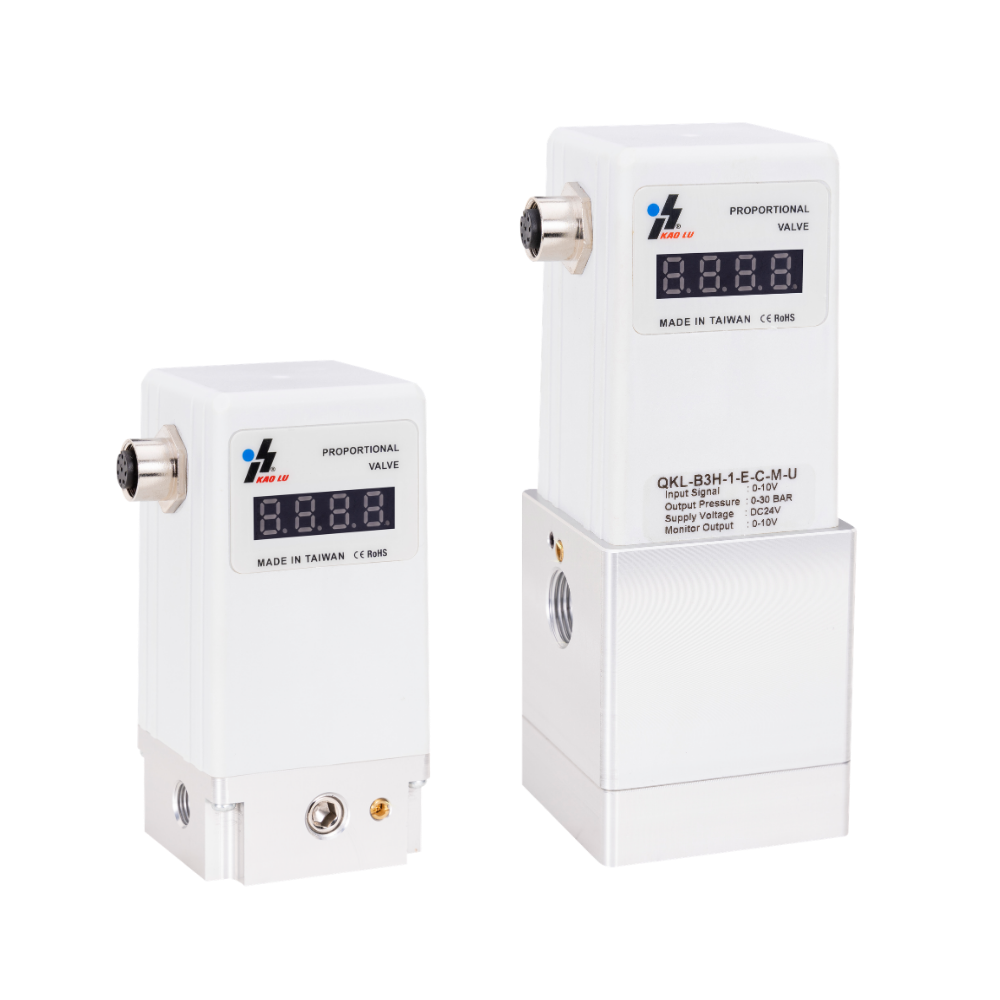
A relieving proportional pressure regulator actively vents downstream gas when the setpoint drops, instead of waiting for the load to consume it. Kao Lu's QKL-B4NR packs 0–30 bar, 200 L/min at 30 bar, 0.2 s response and ±0.25% F.S. accuracy into a PT 1/8" body — five times the flow and ten times the response of the same-size QKL-B1S, with a relieving exhaust for fast pressure drops. Kao Lu Enterprise Co., Ltd. (brand: Kao Lu) took part in the Industrial Development Administration's Conventional Industry Technology Development (CITD) programme for 2025 (ROC year 114) under its enterprise innovation methodology track. With China Productivity Center consultants the company established an NPI (new product introduction) process, a Stage-Gate decision mechanism and an enterprise innovation strategy that set "high pressure, low flow, fast response, compact" medical-grade precision control as the product direction; the QKL-B4NR is that direction's current production model in the 30 bar class.
What did the 2025 CITD programme deliver?
The CITD enterprise innovation methodology track helps traditional manufacturers turn product development from "the owner decides" into a system with process, gates and market evidence. Kao Lu's 2025 project, "Development of a Medical-Grade High-Precision Proportional Pressure Regulator", closed in November 2025 with three deliverables:
- Cross-functional project team and Stage-Gate decisions: R&D, manufacturing, sales and QA form one project team, and a Decision Check Point (DCP) meeting at each gate decides whether to proceed — rather than R&D finishing and handing over to sales.
- CBIS enterprise innovation strategy: PEST, STP, SWOT, customer profile and value-curve analysis confirmed that Kao Lu should not compete head-on with global brands in standard products, but focus on the medical and precision-equipment niche that needs high pressure, low flow, fast response, low noise and small size.
- NPI process (G0–G5) and R&D knowledge management: six gates from concept to production, plus a RAG retrieval prototype built on the company's historical 8D reports so new development can look up past failure modes and countermeasures directly.
Why does the 30 bar class need a relieving regulator?
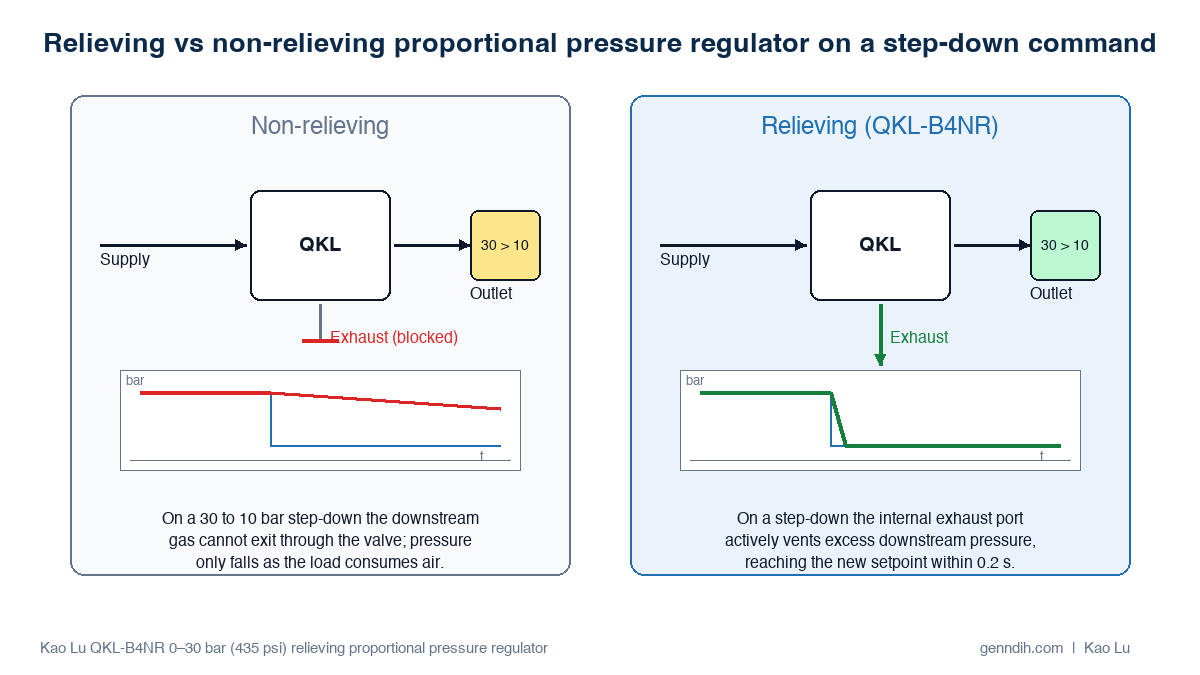
A non-relieving regulator only closes the inlet when the setpoint drops; downstream pressure falls only as the load consumes gas or through slight leakage. For leak testing, laser-cutting pierce/cut switching or PET blow moulding pre-blow/main-blow switching — anywhere pressure must rise and fall several times in one machine cycle — that wait is lost takt time. A relieving design opens the exhaust valve the moment a lower setpoint arrives and vents the downstream gas; the B4NR's 0.2 s response is built on this structure.
Within the same PT 1/8" body, the B4NR raises flow from the B1S's 40 L/min to 200 L/min, cuts response from 2 s to 0.2 s and tightens accuracy from ±0.3% to ±0.25% F.S. For equipment that needs fast multi-stage pressure control in a tight space, it is an upgrade that keeps the mounting footprint.
What are the QKL-B4NR specifications?
| Item | QKL-B4NR | Reference: QKL-B1S (same size) |
|---|---|---|
| Output pressure | 0–30 bar (435 psi) | 0–30 bar |
| Supply max | 34 bar (493 psi) | 34 bar |
| Flow at 30 bar | 200 L/min | 40 L/min |
| Response | 0.2 s | 2 s |
| Accuracy | ±0.25% F.S. | ±0.3% F.S. |
| Repeatability | ±0.25% F.S. | ±0.25% F.S. |
| Exhaust | Relieving (active vent) | Non-relieving |
| Port | PT 1/8" | PT 1/8" |
| Signals | 0–10 V / 4–20 mA / RS485 Modbus command; 1–5 V / 0–10 V / 4–20 mA / RS485 monitor | |
| Power | 24 VDC (5 W) | 24 VDC (≤4 W) |
| Protection / connector | IP65, M12 with 2 m cable, 0–70 °C | |
| Wetted materials | Aluminium, stainless steel, NBR | |
| Weight | 800 g | 420 g |
Source: QKL-B1S / B3H / B4NR datasheet. Test volume and pressure conditions for the response figures are not stated in the datasheet; confirm with the factory before selection.
What does the accuracy mean in real pressure?
| Specification | On a 30 bar range | What it means for the process |
|---|---|---|
| Accuracy ±0.25% F.S. | ±75 mbar | Maximum deviation between setpoint and actual outlet pressure |
| Repeatability ±0.25% F.S. | ±75 mbar | Cycle-to-cycle variation at the same setpoint; leak-test pre-fill and blow-moulding main-blow consistency depend on it directly |
| Response 0.2 s | ≤0.2 s per stage | Five pressure stages per cycle add ≤1 s of switching |
These are specification conversions; actual yield or takt improvement must be measured on the customer's equipment.
How does the CITD market analysis map onto the B4NR?
The STP analysis placed the target market in medical aesthetics equipment, high-precision chemical reaction control, laser cutting, academic laboratories and precision machinery. What they share: mid-to-high pressure, modest flow, and a demand for accuracy, speed, low noise and limited mounting space. The B4NR's 30 bar / 200 L/min / 0.2 s / PT 1/8" sits exactly in that intersection — it is not meant to out-flow large industrial valves, but to deliver speed and accuracy inside a compact body. Typical applications: pre-fill and decay in pressure decay leak testing, assist-gas switching between piercing and cutting in laser cutting, and pre-blow / main-blow staging in blow moulding.
Frequently asked questions
What is the difference between relieving and non-relieving regulators?
A non-relieving regulator only closes the inlet on a lower setpoint, so downstream pressure falls only as the load consumes gas. A relieving regulator opens its exhaust valve and vents the downstream gas. Applications with several pressure rises and falls per cycle, or a closed downstream volume, need a relieving design.
How do I choose between QKL-B4NR and QKL-B1S?
Same size, same range, same signals. For flow up to 40 L/min with no urgency on pressure drops, the B1S is cheaper and draws less power; for 200 L/min, 0.2 s response or fast venting, choose the B4NR.
How does the 2025 CITD programme relate to the QKL-B4NR?
The programme built the development process and market strategy; it did not directly fund B4NR development. Its STP analysis set "high pressure, low flow, fast response, compact" as the direction, and the B4NR is that direction's current production model in the 30 bar class.
Is there a minimum downstream volume?
Yes — at least 40 cm³ of closed-end volume for stable regulation, and a 0–10 V command source must supply at least 3 mA.
Can it regulate oxygen?
Yes, with the datasheet precautions: trained personnel, flushed piping, 5 µm inlet filtration, piped exhaust ports and a supply cut-off circuit for fault conditions.
Need to check whether the QKL-B4NR fits your equipment?
Send your pressure range, flow, number of pressure stages per cycle and switching time, downstream volume and control signal, and an engineer will reply with a recommended model, datasheet and quotation. Request a Quote →
About Kao Lu Enterprise Co., Ltd.
Founded in 1980 and headquartered in Dali, Taichung, Kao Lu was the first company in Taiwan to develop and manufacture I/P and E/P electro-pneumatic proportional valves. Under the Kao Lu brand it designs and builds proportional pressure and flow control valves with 100% in-house production under an ISO 13485-certified process. In recent years the company has received a Taichung City local SBIR grant (2020), CITD enterprise innovation methodology guidance (2025) and a CITD product development grant (2026). The range covers proportional pressure regulators (vacuum to 100 bar), proportional flow control valves (18–200,000 L/min), pinch valves and flow meters.